Retail Store Cleaning Schedules That Minimize Customer Disruption
RETAIL STORE CLEANING SCHEDULES THAT MINIMIZE CUSTOMER DISRUPTION
Learn how to schedule retail cleaning during off-peak hours, use zone-based systems, and implement the 20-10 rule to keep stores spotless without disrupting shoppers.
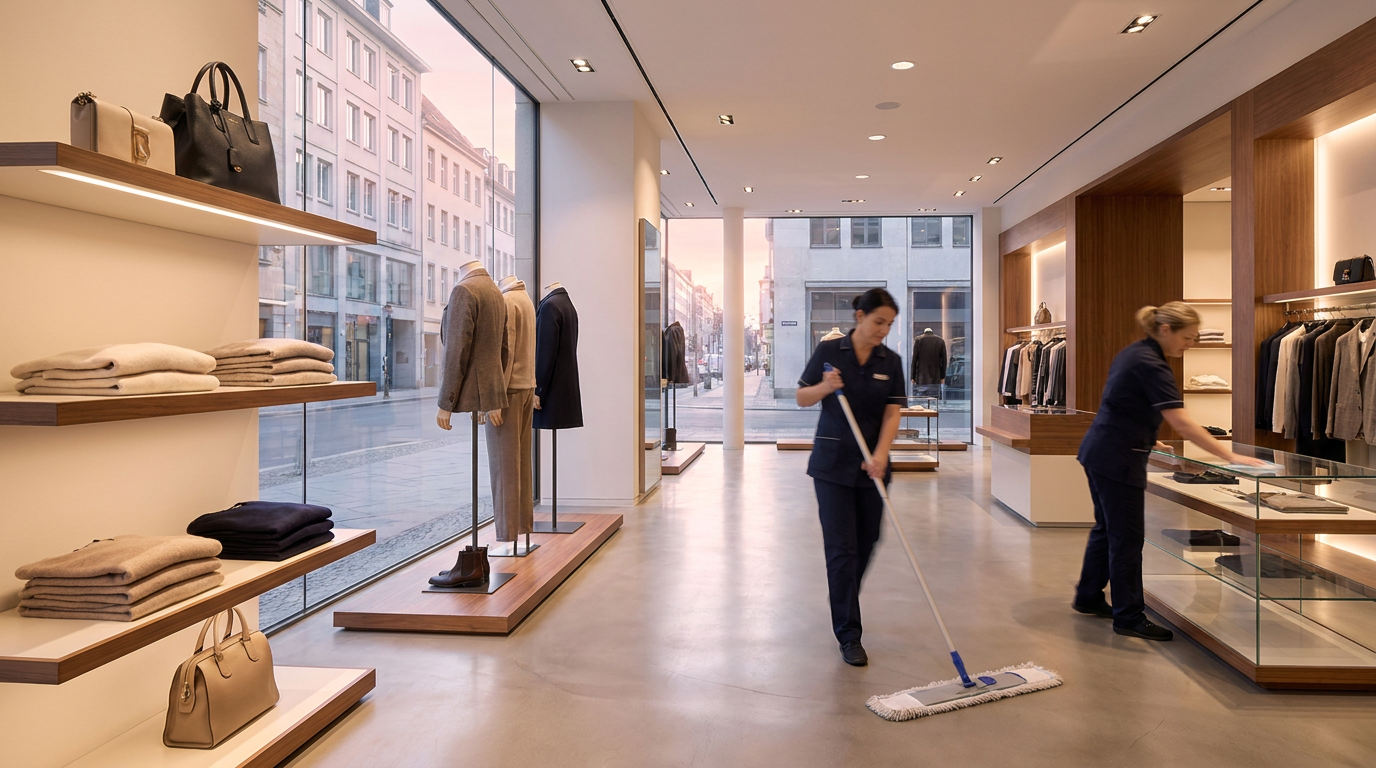
The most effective retail cleaning schedule divides tasks into three tiers: continuous light cleaning during business hours, zone-based deep cleaning during slow periods, and intensive floor restoration after closing. This approach keeps stores presentable while protecting the customer experience and maintaining sales momentum.
- Schedule intensive floor care (stripping, waxing, extraction) for after-hours only, typically between 10 PM and 6 AM
- Use the 20-10 rule: clean for 20 minutes, then step back for 10 minutes to let customers shop undisturbed
- Zone-based cleaning reduces visible disruption by 40-60% compared to full-store cleaning during open hours
- Peak shopping hours (11 AM to 3 PM, 5 PM to 8 PM) should have zero visible cleaning equipment on the sales floor
- Professional retail cleaning services cost $0.40 to $2.00 per square foot depending on floor type and service scope
Understanding the Three-Tier Retail Cleaning System
Retail environments require a fundamentally different cleaning approach than offices or warehouses. According to industry research from i-team, customer perception of store cleanliness directly impacts purchase decisions, with 78% of shoppers reporting they would leave a store that appeared dirty. The three-tier system addresses this by matching cleaning intensity to customer traffic patterns.
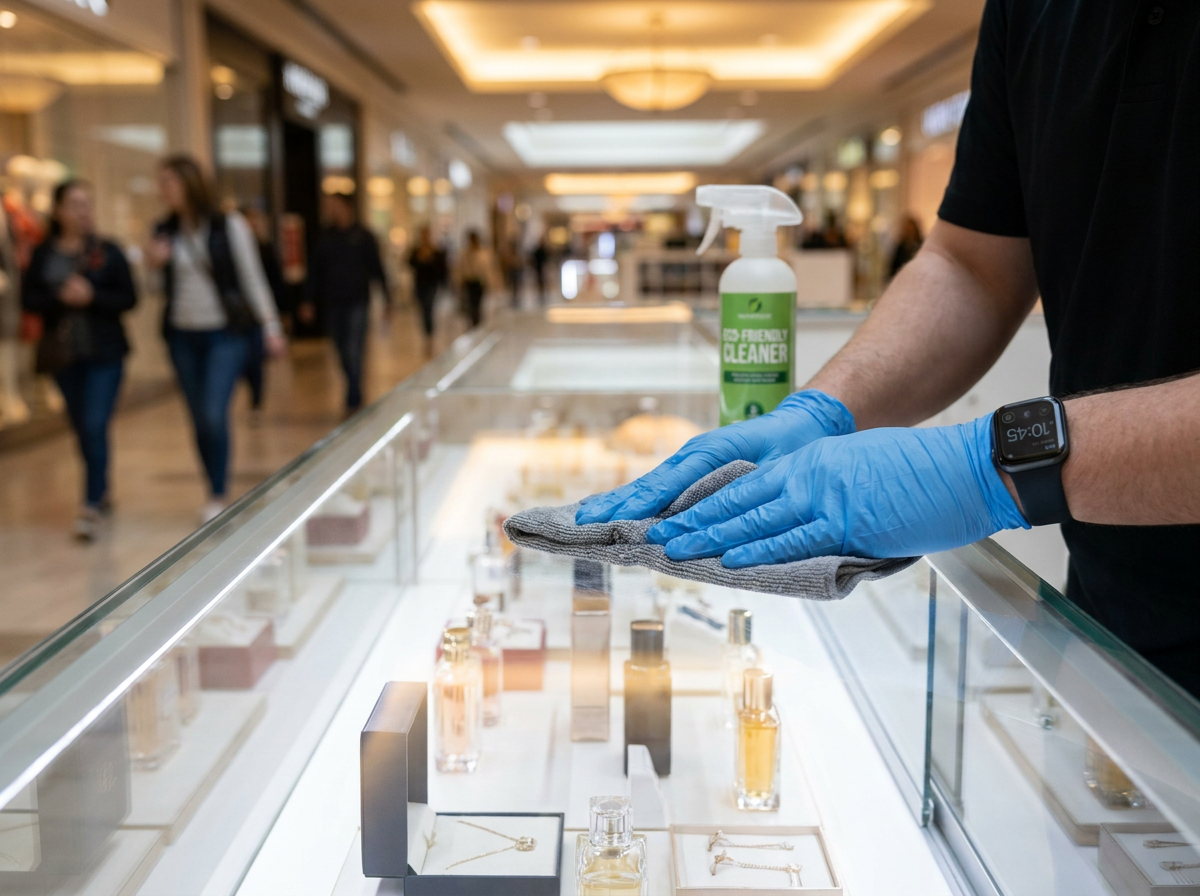
Tier one involves continuous maintenance during all operating hours. This includes spot cleaning spills within 3 minutes, restocking restroom supplies every 2 hours, and wiping high-touch surfaces like door handles and checkout counters every 30 to 60 minutes. Staff should use small, handheld equipment that does not block aisles or create safety hazards.
Tier two covers zone-based deep cleaning during predictable slow periods. Most retail stores experience traffic drops between 2 PM and 4 PM on weekdays and before 11 AM on weekends. During these windows, teams can address specific zones with more intensive equipment while maintaining normal operations in other areas.
Tier three encompasses intensive restoration work scheduled exclusively after closing. Floor stripping, waxing, carpet extraction, and pressure washing require extended dry times and create temporary safety hazards. These services should never overlap with customer access.
The 20-10 Rule for Cleaning During Business Hours
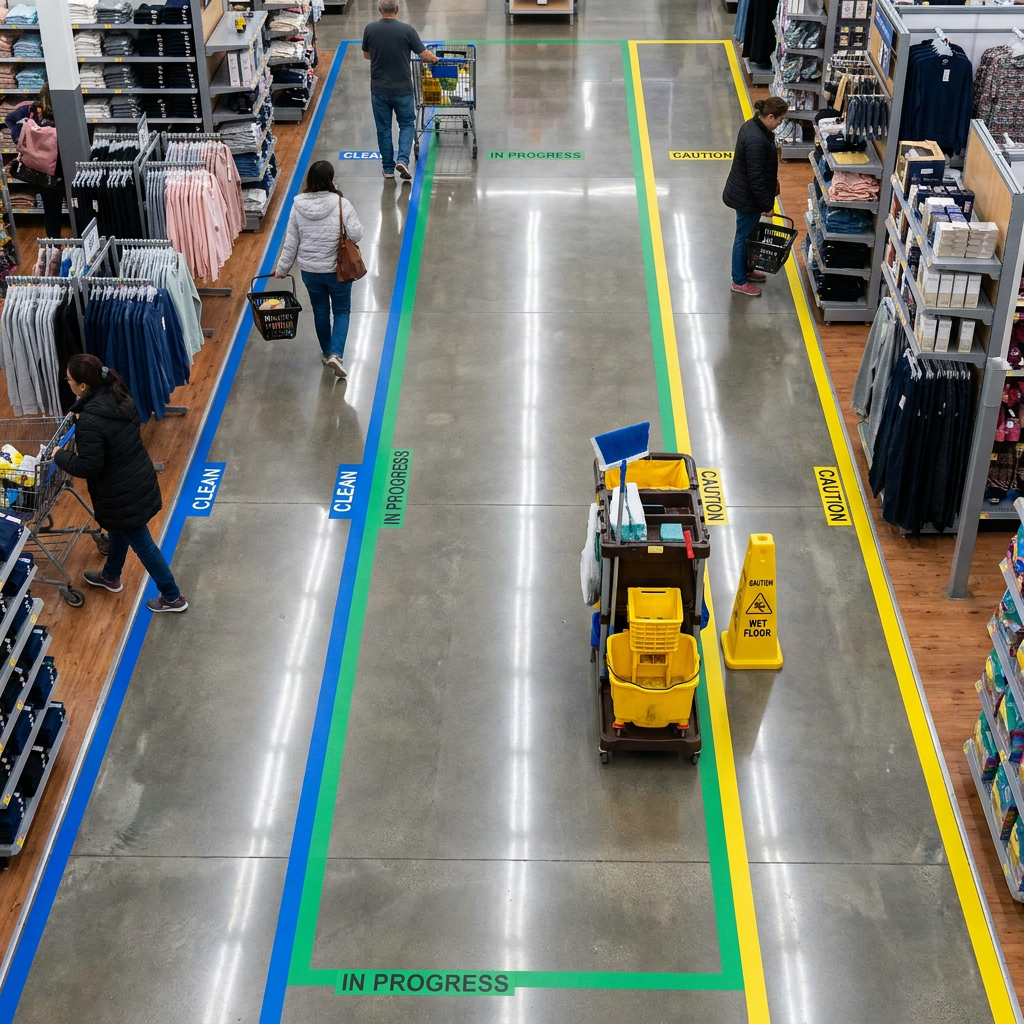
The 20-10 rule provides a practical framework for maintaining cleanliness without creating customer friction. Staff clean actively for 20 minutes, then step back for 10 minutes to allow unobstructed shopping. This rhythm prevents the common problem of cleaning crews blocking product displays or creating wet floor hazards during peak shopping.
Implementation requires clear zone assignments. A 10,000 square foot retail space typically divides into 4 to 6 cleaning zones. Each zone receives its 20-minute cleaning window on a rotating schedule, ensuring every area receives attention while no single zone experiences prolonged disruption.
The rule also applies to equipment visibility. Cleaning carts, mop buckets, and vacuum cleaners should remain in back-of-house areas during the 10-minute rest periods. According to ServiceChannel research, visible cleaning equipment reduces customer dwell time by an average of 12%, directly impacting sales per visitor.
Four Components of a Master Cleaning Schedule
A complete master cleaning schedule contains four essential components: task frequency matrix, time allocation windows, responsibility assignments, and quality verification checkpoints. Missing any component creates gaps that lead to either customer disruption or inadequate cleaning.
Task Frequency Matrix
The frequency matrix categorizes every cleaning task by how often it must occur. High-traffic areas like entrances and checkout zones require attention every 1 to 2 hours. Secondary areas like mid-store aisles need cleaning every 4 to 6 hours. Storage rooms and back-of-house areas may only require daily attention.
Floor care follows its own frequency schedule. VCT and vinyl floors in retail environments typically need professional scrub and recoat service every 3 to 6 months to maintain appearance, with full floor stripping and waxing annually or when visible yellowing and edge buildup appear.
Time Allocation Windows
Effective schedules block specific time windows for different cleaning intensities. The following table shows optimal timing for common retail cleaning tasks:
| Cleaning Task | Optimal Time Window | Duration | Customer Impact |
|---|---|---|---|
| Spot cleaning and spill response | Continuous (all hours) | 3 to 5 minutes | Minimal |
| Restroom deep cleaning | 2 PM to 4 PM weekdays | 20 to 30 minutes | Low |
| Auto-scrubber floor cleaning | Before opening or after close | 45 to 90 minutes | None |
| Floor stripping and waxing | 10 PM to 6 AM | 4 to 8 hours | None |
| Carpet extraction | After close (24-hour dry time) | 2 to 4 hours | None |
| Window and glass cleaning | Before opening | 30 to 60 minutes | None |
Responsibility Assignments
Clear responsibility assignments prevent both duplication and gaps. In-house staff typically handle tier one continuous maintenance. Tier two zone cleaning may involve either trained employees or contracted day porters. Tier three intensive services almost always require professional commercial cleaning contractors with industrial equipment.
The International Sanitary Supply Association (ISSA) recommends documenting assignments in writing, with specific names or positions attached to each task. This documentation proves essential during inspections and provides accountability for quality standards.
Quality Verification Checkpoints
Verification checkpoints ensure cleaning actually meets standards. Effective retail operations include manager walk-throughs every 4 hours during business hours, with documented checklists covering floor appearance, restroom condition, and high-touch surface cleanliness. Before and after photography provides objective evidence of cleaning completion.
The 5 Rules of Smart Cleaning for Retail Environments
Smart cleaning principles maximize cleanliness while minimizing labor costs and customer disruption. These five rules guide efficient retail cleaning operations:
Rule 1: Clean from top to bottom. Dust and debris fall downward. Starting with high dusting, then working to mid-level surfaces, then floors prevents re-contamination. This sequence reduces total cleaning time by 15 to 20%.
Rule 2: Clean from back to front. Work from the rear of the store toward the entrance. This approach keeps cleaned areas behind you and prevents tracking dirt across freshly cleaned floors. It also ensures the entrance, the highest-impact area, receives attention last and stays pristine for customers.
Rule 3: Clean dry before wet. Remove loose debris with dry methods (sweeping, dust mopping, vacuuming) before applying any liquid cleaning solutions. Wet cleaning over loose dirt creates mud and streaks that require additional effort to remove.
Rule 4: Let chemicals do the work. Apply cleaning solutions and allow proper dwell time, typically 2 to 5 minutes for general cleaners and 10 to 15 minutes for heavy-duty degreasers, before scrubbing. This reduces physical labor and improves results.
Rule 5: Use the right tool for the task. Microfiber cloths capture 99% of bacteria versus 33% for cotton. HEPA-filtered vacuums trap particles that standard vacuums recirculate. Industrial auto-scrubbers clean 10 times faster than mop-and-bucket methods. Proper equipment selection dramatically impacts both efficiency and outcomes.
The 5 Basic Cleaning Principles Applied to Retail
Beyond smart cleaning rules, five fundamental principles govern effective cleaning chemistry and technique. Understanding these principles helps retail managers evaluate cleaning contractor quality and troubleshoot persistent cleanliness issues.
Time: Chemical contact time directly affects cleaning effectiveness. Rushing through cleaning by wiping immediately after application reduces soil removal by 40 to 60%. Retail schedules must account for dwell time, not just application time.
Temperature: Higher temperatures accelerate chemical reactions and improve soil dissolution. Hot water extraction for carpets removes 30% more soil than cold water methods. However, some surfaces, including certain vinyl compositions, can be damaged by excessive heat.
Agitation: Mechanical action breaks the bond between soil and surfaces. Auto-scrubbers provide consistent agitation across large floor areas. Hand scrubbing remains necessary for grout lines, corners, and textured surfaces where machines cannot reach.
Chemical concentration: More is not better. Over-concentrated solutions leave residue that attracts new soil faster. Under-concentrated solutions fail to clean effectively. Professional cleaning services use calibrated dilution systems to maintain proper concentrations.
Procedure: The sequence of steps matters as much as individual techniques. The ISSA Cleaning Industry Management Standard (CIMS) provides documented procedures that ensure consistent results across different staff members and locations.
Zone-Based Cleaning Strategies for Multi-Tenant Retail Centers
Shopping centers and multi-tenant retail properties face unique scheduling challenges. Common areas require coordination across multiple business hours, and individual tenant spaces may have conflicting cleaning preferences. Zone-based strategies address these complexities.
Common area cleaning in South Florida retail centers typically follows a three-shift model. The early morning shift (5 AM to 9 AM) handles intensive floor care before most stores open. The midday shift (10 AM to 6 PM) focuses on continuous maintenance, restroom service, and food court cleaning. The evening shift (8 PM to midnight) addresses accumulated daily soil and prepares for the next day.
Professional retail and shopping center cleaning services can manage multi-tenant properties under a single contract, providing consistent quality across all common areas while coordinating with individual tenant schedules. This approach eliminates the confusion of multiple vendors and ensures no gaps in coverage.
According to CEM Janitorial Services, establishing predictable cleaning routines is essential for minimizing retail floor disruptions. When tenants and customers know what to expect, they can plan around cleaning activities rather than being surprised by wet floors or blocked aisles.
Floor Type Considerations for Retail Cleaning Schedules
Different floor materials require different cleaning frequencies and techniques. South Florida retail environments commonly feature VCT (vinyl composition tile), luxury vinyl plank, polished concrete, terrazzo, and ceramic tile. Each material has specific maintenance requirements that impact scheduling.
VCT Floors
VCT remains the most common retail flooring due to its low cost ($2 to $4 per square foot installed) and durability. However, VCT requires regular wax maintenance to maintain appearance. High-traffic retail locations need scrub and recoat service every 3 to 4 months and full strip and wax annually. These services cost $0.60 to $1.80 per square foot and require 4 to 8 hours of dry time.
Polished Concrete
Polished concrete has gained popularity in modern retail environments. It requires less frequent intensive maintenance than VCT but needs daily dust mopping and periodic re-polishing every 12 to 24 months. Commercial floor deep cleaning for polished concrete costs $0.50 to $1.50 per square foot.
Terrazzo
Terrazzo floors, common in South Florida retail properties built before 1990, require specialized diamond polishing to maintain their characteristic shine. Professional terrazzo restoration costs $0.60 to $2.00 per square foot and should occur every 2 to 3 years in retail environments.
Ceramic Tile
Ceramic tile surfaces clean easily but grout lines present ongoing challenges. Retail environments should schedule professional grout cleaning every 6 to 12 months, with more frequent spot treatment in food service areas. Steam cleaning provides the most effective grout restoration without harsh chemicals.
Scheduling Intensive Cleaning Around Peak Retail Seasons
Retail traffic patterns vary dramatically by season, requiring schedule adjustments throughout the year. Smart operators plan intensive cleaning services during predictable slow periods rather than attempting them during peak seasons.
For South Florida retail, the optimal windows for intensive floor restoration include:
- Late January through February: Post-holiday traffic decline before spring break
- May through early June: Between spring break and summer tourist season
- September through early October: Post-summer, pre-holiday preparation
Avoid scheduling floor stripping, carpet extraction, or other intensive services during November through December (holiday shopping), March (spring break tourism), or July through August (back-to-school and summer tourism peaks).
As noted by ServiceChannel, scheduling yearly store-wide intensive cleaning during off-peak months like March or April avoids problems and ensures maximum operational efficiency.
Equipment Selection for Low-Disruption Retail Cleaning
Equipment choice significantly impacts customer disruption levels. Modern commercial cleaning equipment offers features specifically designed for occupied retail environments.
Low-decibel vacuums: Standard commercial vacuums produce 70 to 85 decibels, roughly equivalent to a busy restaurant. Low-noise models operate at 55 to 65 decibels, similar to normal conversation. The difference dramatically reduces customer disturbance during business hours.
Compact auto-scrubbers: Walk-behind auto-scrubbers with 17 to 20 inch cleaning paths can navigate retail aisles without blocking traffic. These machines clean and dry floors in a single pass, eliminating wet floor hazards that require caution signs and customer rerouting.
Battery-powered equipment: Cordless vacuums, scrubbers, and floor machines eliminate trip hazards from power cords stretched across aisles. Battery technology has improved dramatically, with modern lithium-ion packs providing 2 to 4 hours of continuous operation.
HEPA filtration: High-efficiency particulate air filters capture 99.97% of particles 0.3 microns and larger. This prevents the dust recirculation common with standard vacuums, which can trigger customer allergies and settle on merchandise.
Staff Training Requirements for Customer-Friendly Cleaning
Even the best schedule fails without properly trained staff. Retail cleaning personnel need specific training beyond basic cleaning techniques.
Customer interaction protocols: Staff should know how to respond when customers approach during cleaning. This includes pausing work to allow passage, answering basic questions, and directing customers to appropriate staff for assistance.
Safety signage placement: Wet floor signs must be visible from all approach directions. Training should cover proper sign positioning, including at aisle entrances rather than only at the wet area itself.
Emergency response: Spill response training ensures staff can address hazards within the 3-minute window that prevents slip-and-fall incidents. This includes knowing spill kit locations, proper cleanup procedures for different spill types, and documentation requirements.
Equipment operation: Staff operating auto-scrubbers, extractors, or other powered equipment need documented training on safe operation, including pedestrian awareness and emergency stop procedures.
Measuring Cleaning Schedule Effectiveness
Effective retail cleaning schedules require ongoing measurement and adjustment. Key performance indicators help identify when schedules need modification.
Customer complaint tracking: Document all cleanliness-related customer complaints by location, time, and nature. Patterns reveal schedule gaps. A spike in restroom complaints at 4 PM, for example, indicates the midday cleaning window ends too early.
Slip-and-fall incident rates: The Occupational Safety and Health Administration (OSHA) reports that slips, trips, and falls account for 15% of all accidental deaths and are the leading cause of workers' compensation claims. Tracking incidents by time and location identifies high-risk periods requiring schedule adjustment.
Floor appearance scores: Weekly floor inspections using a standardized 1 to 10 scoring system provide objective quality data. Scores below 7 indicate maintenance frequency needs to increase. Consistently high scores may allow reduced frequency, lowering costs.
Labor efficiency metrics: Track square footage cleaned per labor hour. Industry benchmarks for retail environments range from 2,500 to 4,000 square feet per hour for routine maintenance and 500 to 1,000 square feet per hour for intensive floor care. Significant deviations suggest training needs or equipment issues.
Working with Professional Retail Cleaning Services
Many retail operators find that professional cleaning contractors deliver better results than in-house staff for intensive and specialized services. Professional services bring industrial-grade equipment, trained technicians, and scheduling flexibility that internal teams cannot match.
When evaluating retail cleaning contractors, consider these factors:
Equipment capabilities: Professional services should own ride-on scrubbers for large floor areas, truck-mounted extractors for carpet deep cleaning, and industrial pressure washers for exterior surfaces. Companies relying solely on consumer-grade equipment cannot deliver commercial-quality results.
Scheduling flexibility: Retail cleaning often requires overnight or early morning service. Contractors must demonstrate ability to work outside normal business hours without premium charges that make service cost-prohibitive.
Insurance and licensing: Verify general liability insurance of at least $1 million per occurrence and workers' compensation coverage. In Florida, contractors should hold appropriate business licenses for the counties they serve.
References from similar properties: Request references from retail clients of similar size and type. A contractor experienced with office buildings may not understand retail-specific challenges like merchandise protection and customer flow management.
For South Florida retail properties, requesting a free on-site assessment from a qualified commercial cleaning company provides detailed information about your specific floor types, condition, and recommended service frequency.
Frequently Asked Questions
What is the 20-10 rule for cleaning?
The 20-10 rule is a cleaning rhythm designed for occupied spaces. Staff clean actively for 20 minutes, then step back for 10 minutes to allow customers to shop without obstruction. During the 10-minute pause, cleaning equipment returns to back-of-house areas, and staff can restock supplies or address other tasks. This pattern repeats throughout business hours, ensuring continuous progress while minimizing customer disruption.
What are four components that should be included in a master cleaning schedule?
A complete master cleaning schedule includes: (1) a task frequency matrix specifying how often each cleaning task occurs, (2) time allocation windows defining when specific tasks should happen, (3) responsibility assignments identifying who performs each task, and (4) quality verification checkpoints ensuring work meets standards. Missing any component creates accountability gaps and inconsistent results.
What are the 5 rules of smart cleaning?
The five rules of smart cleaning are: (1) clean from top to bottom to prevent re-contamination from falling debris, (2) clean from back to front to keep cleaned areas behind you, (3) clean dry before wet by removing loose debris before applying solutions, (4) let chemicals do the work by allowing proper dwell time, and (5) use the right tool for the task to maximize efficiency and effectiveness.
What are the 5 basic cleaning principles?
The five basic cleaning principles are time, temperature, agitation, chemical concentration, and procedure. Time refers to chemical contact duration. Temperature affects chemical reaction rates. Agitation provides mechanical soil removal. Chemical concentration must be properly calibrated for effectiveness without residue. Procedure ensures consistent application of all principles in the correct sequence.
Need a Retail Cleaning Schedule That Works?
MB Clean Solutions specializes in retail floor care throughout Miami-Dade, Broward, and Palm Beach counties. Our overnight scheduling and industrial equipment deliver showroom-quality floors without disrupting your customers or sales.
Get Your Free AssessmentKeep reading
More guides on the same topic from our team.
How to Choose a Commercial Cleaning Service for Office Buildings
Learn the 7 essential criteria for selecting a commercial cleaning service for office buildings, including pricing, certifications, and evaluation checklists.
Read the guide
Office Building Cleaning Checklist: Complete Guide for 2026
Comprehensive office building cleaning checklist covering daily, weekly, and monthly tasks. Includes high-touch surfaces, restrooms, floors, and deep cleaning schedules.
Read the guide
How to Prepare Your Office for Post-Construction Cleaning
Learn the exact steps to prepare an office for post-construction cleaning. Covers the 3 phases, common mistakes, and GC coordination for faster CO approval.
Read the guide
Ready for a Spotless Space?
Get a free, no-obligation estimate for your commercial cleaning project. Most quotes delivered within 24 hours.