How to Evaluate Commercial Cleaning Proposals and Contracts
HOW TO EVALUATE COMMERCIAL CLEANING SERVICE PROPOSALS AND CONTRACTS
Learn exactly what to look for in commercial cleaning proposals and contracts. Includes pricing benchmarks, red flags, key clauses, and a comparison checklist.
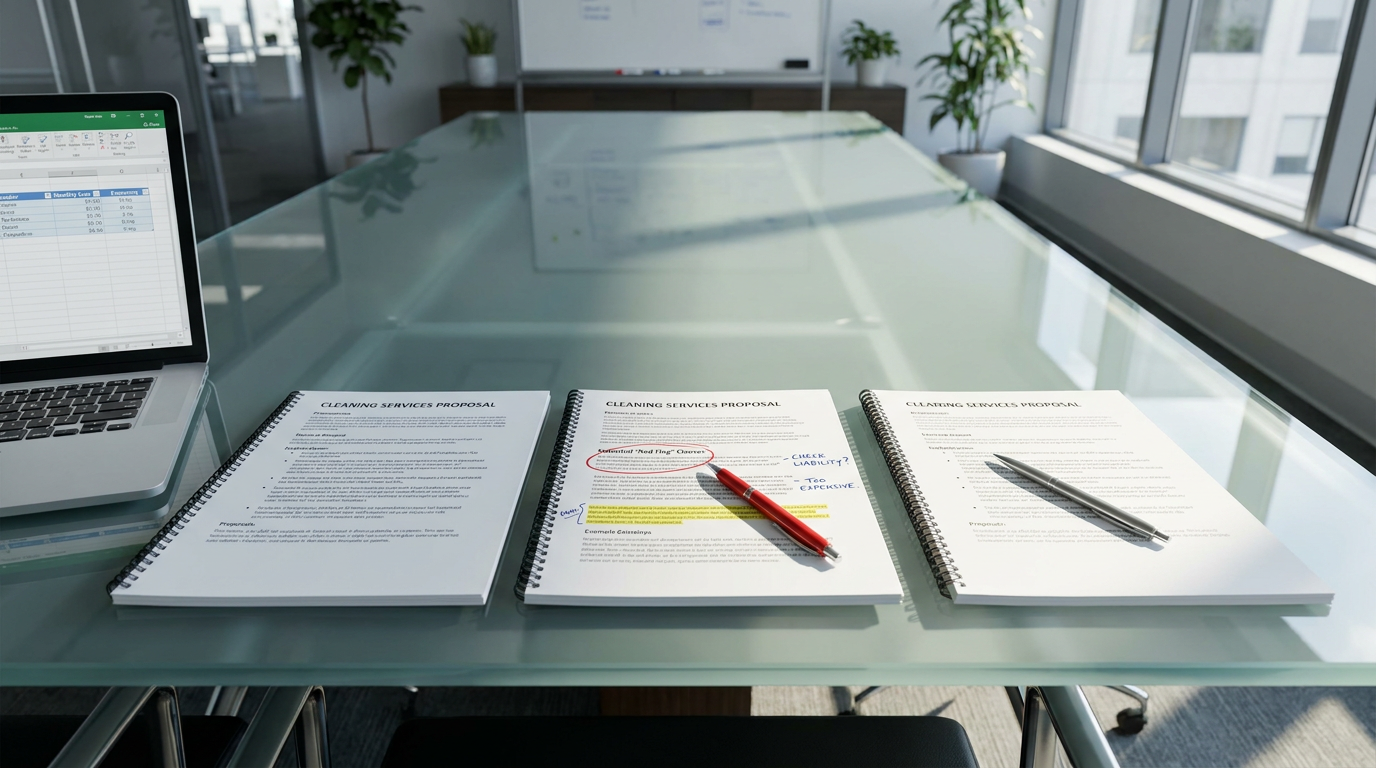
Evaluate commercial cleaning proposals by comparing scope of work, staffing levels, quality control processes, insurance coverage, and contract terms across all vendors. The lowest bid often excludes critical services or supervision, so focus on what is included rather than total price alone. A thorough evaluation takes 30 to 60 minutes per proposal and can prevent thousands of dollars in hidden costs or service failures.
- Commercial cleaning costs range from $0.05 to $0.50 per square foot for janitorial services and $0.40 to $2.00 per square foot for deep cleaning or floor restoration
- Proposals must specify exact rooms, tasks, frequencies, and staffing hours to allow accurate comparison
- Contract red flags include vague "as needed" language, auto-renewal clauses, and unlimited price escalation rights
- Quality control documentation, insurance certificates, and termination clauses are non-negotiable requirements
- Specialty services like floor stripping and waxing should be quoted separately with per-square-foot pricing
Why Proposal Evaluation Matters More Than Price
According to the Building Service Contractors Association International (BSCAI), the most common mistake facility managers make is comparing proposals based solely on the bottom-line price. Two proposals quoting $2,500 per month may include vastly different service levels, labor hours, and supervision structures.
A 2024 ISSA industry survey found that 67% of commercial cleaning contract disputes stem from unclear scope definitions in the original proposal. These disputes cost an average of $4,200 in remediation expenses and 12 hours of management time per incident.
The evaluation process protects your facility, your budget, and your relationship with the cleaning vendor. Taking 45 to 60 minutes to properly review each proposal prevents months of frustration with substandard service.
The 8 Essential Components of a Commercial Cleaning Proposal
Every commercial cleaning proposal should contain eight distinct sections. Missing sections indicate either an inexperienced vendor or intentional vagueness designed to allow scope creep.
1. Scope of Work Definition
The scope section must list every room, area, and surface included in the service. Vague descriptions like "common areas" or "restrooms as needed" create disputes. Look for specific room counts, square footage measurements, and surface types (VCT, carpet, tile, concrete).
A complete scope includes daily tasks (trash removal, vacuuming, restroom cleaning), weekly tasks (mopping, dusting), monthly tasks (window interiors, vent cleaning), and periodic tasks (carpet extraction, floor restoration). Each task should specify the method, not just the outcome.
2. Service Frequency Schedule
Frequency determines labor hours and directly affects price. A proposal stating "cleaning 3 times per week" differs significantly from one stating "Monday, Wednesday, Friday from 6 PM to 10 PM." The second version commits the vendor to specific accountability.
For South Florida commercial properties, humidity and foot traffic often require more frequent floor care than properties in drier climates. Standard janitorial might be 3 to 5 days per week, while high-traffic retail or hospitality spaces may need daily or twice-daily service.
3. Staffing Plan and Labor Hours
The proposal should specify how many cleaners will work your facility, their scheduled hours, and whether a supervisor will conduct regular inspections. A 10,000 square foot office typically requires 2 to 3 labor hours per cleaning session for basic janitorial service.
Ask whether staff are W-2 employees or subcontractors. According to the U.S. Department of Labor, misclassification of cleaning workers as independent contractors exposes property managers to potential liability if the vendor faces an audit.
4. Supplies and Equipment Details
Proposals must clarify what is included versus billed separately. Basic consumables (paper towels, soap, trash liners) may or may not be included. Specialty equipment for floor care, pressure washing, or carpet extraction is typically provided by the vendor but should be explicitly stated.
For commercial floor deep cleaning, vendors should specify whether they use industrial auto-scrubbers, rotary machines, or manual methods. Equipment quality directly affects results, especially for VCT, terrazzo, and polished concrete surfaces.
5. Quality Control Process
A credible proposal describes how the vendor measures and maintains quality. Look for inspection checklists, photo documentation, supervisor visit schedules, and escalation procedures. The best vendors provide digital reporting through platforms like Swept, CleanTelligent, or OrangeQC.
Quality control should include a defined response time for complaints (typically 4 to 24 hours) and a process for recurring issues. Without documented quality control, you have no leverage when service declines.
6. Insurance and Compliance Documentation
Every proposal must include proof of general liability insurance (minimum $1 million per occurrence), workers' compensation coverage, and any required licenses. In Florida, commercial cleaning companies must carry workers' compensation if they have four or more employees.
Request certificates of insurance naming your property as an additional insured. Verify coverage dates and confirm the policy is active by calling the insurance carrier directly. Expired or fraudulent insurance documentation is more common than most property managers realize.
7. Specialty Services and Pricing
Specialty services like floor stripping and waxing, carpet extraction, pressure washing, and post-construction cleanup should be quoted separately with per-square-foot pricing. Bundling these services into a monthly rate obscures their true cost and makes comparison impossible.
Standard pricing benchmarks for South Florida specialty services:
| Service Type | Price Range (per sq ft) | Typical Frequency |
|---|---|---|
| VCT Floor Stripping and Waxing | $0.85 to $1.80 | Annually or semi-annually |
| Scrub and Recoat | $0.60 to $1.50 | Every 3 to 6 months |
| Commercial Carpet Extraction | $0.15 to $0.35 | Quarterly |
| Terrazzo Floor Restoration | $0.60 to $2.00 | Every 1 to 3 years |
| Post-Construction Cleanup | $0.40 to $2.00 | Project-based |
| Pressure Washing (exterior) | $0.08 to $0.25 | Quarterly to annually |
8. Contract Terms Summary
The proposal should preview key contract terms including initial term length, renewal provisions, termination notice requirements, and price adjustment mechanisms. If these terms are missing from the proposal, they will likely appear in the contract with language favoring the vendor.

How to Compare Commercial Cleaning Proposals Side by Side
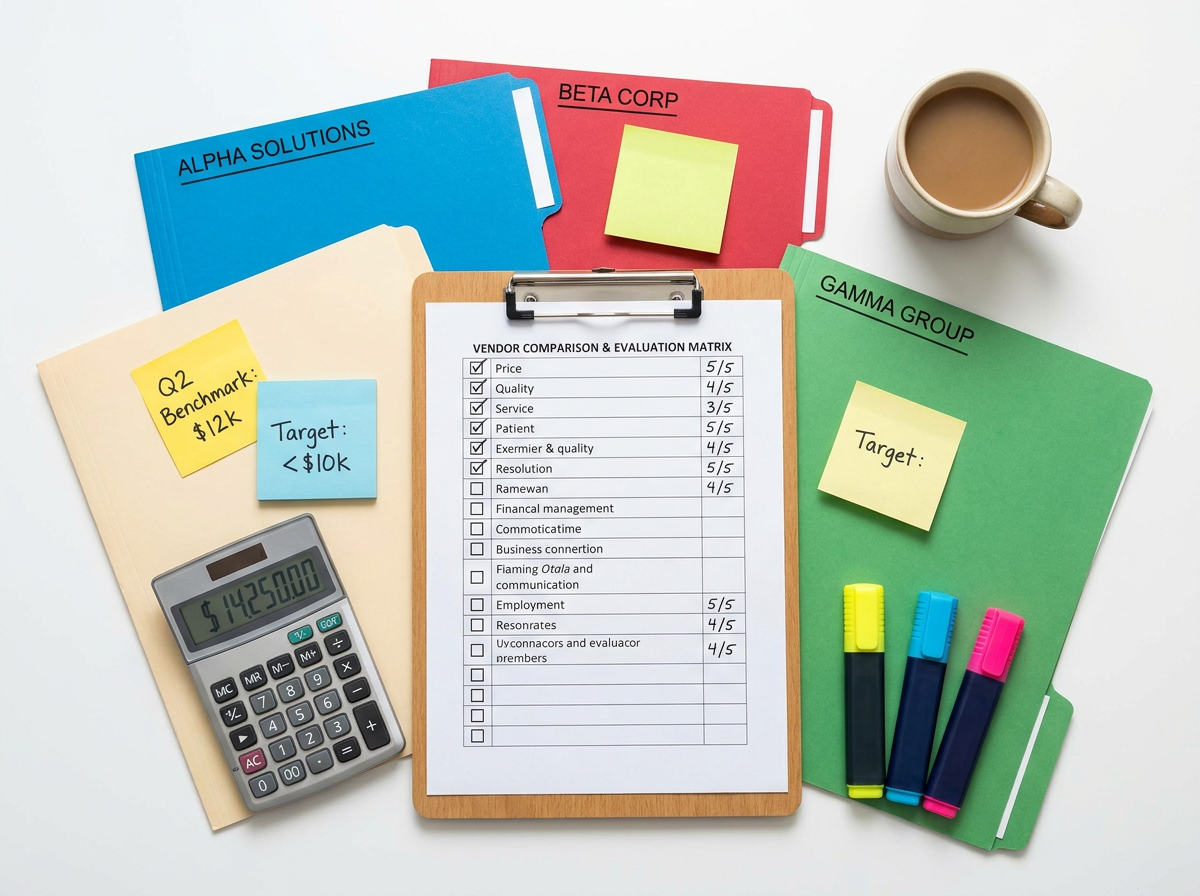
Create a standardized comparison matrix before reviewing any proposals. This prevents the common trap of being swayed by professional presentation or persuasive sales language rather than substance.
The Proposal Comparison Checklist
Use this framework to evaluate each proposal on equal terms:
| Evaluation Criteria | What to Verify | Why It Matters |
|---|---|---|
| Scope Match | Same rooms, surfaces, and task list | Prevents false price comparisons |
| Frequency Match | Same days and times of service | Labor hours drive cost |
| Labor Hours | Estimated hours per visit | Affects thoroughness and coverage |
| Supervision Level | Inspection frequency and process | Drives consistent quality |
| Supplies Included | Paper goods, chemicals, liners | Prevents surprise charges |
| Equipment Provided | Type and condition of machines | Affects cleaning effectiveness |
| Insurance Limits | GL and WC coverage amounts | Protects against liability |
| Termination Terms | Notice period and exit conditions | Limits long-term risk |
Normalizing Price for Accurate Comparison
Convert all proposals to a common metric: cost per cleanable square foot per month. This calculation accounts for differences in facility size measurements and service frequency.
Formula: Monthly Price divided by (Cleanable Square Feet multiplied by Monthly Service Visits) equals Cost Per Square Foot Per Visit.
A 6,000 square foot office receiving service 3 times per week (approximately 13 visits per month) at $1,500 monthly costs $0.019 per square foot per visit. Compare this to a vendor quoting $1,200 monthly for twice-weekly service (approximately 9 visits), which costs $0.022 per square foot per visit. The "cheaper" quote actually costs more per cleaning.
Critical Contract Clauses to Review Before Signing
The proposal is a sales document. The contract is the legal commitment. Never assume the contract matches the proposal; review every clause and request amendments where needed.
Service Level Agreement (SLA) Terms
The contract should define measurable performance standards, not vague quality promises. Look for specific metrics like "restrooms will be cleaned and restocked daily" rather than "restrooms will be maintained in satisfactory condition."
Effective SLAs include response time commitments (complaints addressed within 24 hours), inspection scores (minimum 85% on quality audits), and remediation procedures (re-cleaning at no charge for failed inspections).
Termination and Exit Provisions
Most commercial cleaning contracts require 30 to 60 days written notice for termination. Watch for contracts requiring 90 days or longer, as these limit your flexibility to change vendors if service deteriorates.
Termination for cause should be clearly defined and should include repeated service failures, insurance lapses, or failure to maintain required licenses. Some contracts make termination for cause nearly impossible by requiring extensive cure periods.
Price Escalation Language
Annual price increases are standard in multi-year contracts, but the mechanism matters. Acceptable language ties increases to a specific index (Consumer Price Index) or caps increases at 3% to 5% annually. Unacceptable language allows "price adjustments at vendor's discretion" or ties increases to undefined "market conditions."
The ISSA (International Sanitary Supply Association) recommends that commercial cleaning contracts include price adjustment caps and require 60 days advance notice before any rate change takes effect.
Auto-Renewal Provisions
Many cleaning contracts include automatic renewal clauses that extend the agreement for additional terms unless you provide written notice 60 to 90 days before expiration. Mark your calendar for these deadlines and send termination or renegotiation notices via certified mail.
In Florida, automatic renewal clauses in commercial contracts are enforceable if clearly stated. The burden falls on you to track renewal dates and provide timely notice.
Indemnification and Liability
The contract should require the vendor to indemnify you against claims arising from their work, including employee injuries, property damage, and third-party claims. Review the indemnification language with your legal counsel, especially for properties with high liability exposure like medical facilities or schools.
Ensure the contract does not include broad indemnification running in the vendor's favor, which would make you responsible for claims that should be the vendor's responsibility.
Subcontracting Rights
Some vendors subcontract specialty work like post-construction cleaning or floor restoration to third parties. The contract should specify whether subcontracting is permitted and require that subcontractors meet the same insurance and background check requirements as the primary vendor.
Red Flags That Should Disqualify a Proposal
Certain proposal characteristics indicate either inexperience or intentional evasion. Treat these as disqualifying factors unless the vendor can provide satisfactory explanations.
Vague Scope Language
Phrases like "as needed," "upon request," or "general cleaning" without definitions create disputes. Every task should have a defined frequency and method. If the proposal says "floors will be maintained," ask whether that means daily dust mopping, weekly wet mopping, or monthly machine scrubbing.
Missing Insurance Documentation
A proposal without attached insurance certificates suggests the vendor either lacks coverage or is unwilling to provide proof. Request certificates before the proposal review meeting and verify coverage directly with the insurance carrier.
No Quality Control Process
Vendors who cannot describe their inspection process, reporting system, or complaint resolution procedure likely have no structured quality control. This predicts inconsistent service and difficult dispute resolution.
Unusually Low Pricing
Pricing significantly below market rates (more than 25% lower than comparable proposals) indicates either misunderstanding of the scope, intent to cut corners, or a bait-and-switch strategy where prices increase after the contract is signed.
According to industry data from Aspire Software, commercial cleaning companies operate on 10% to 15% net profit margins. Vendors quoting dramatically lower prices are either losing money or cutting labor hours below what the scope requires.
Pressure Tactics
Proposals with artificial deadlines ("price valid for 48 hours only") or high-pressure sales tactics suggest a vendor more focused on closing deals than building long-term relationships. Reputable vendors understand that facility managers need time to evaluate proposals properly.
Questions to Ask Before Selecting a Vendor
Schedule a call or meeting with your top two or three vendors to clarify proposal details and assess their professionalism. These questions reveal operational capability beyond what appears on paper.
Staffing and Training Questions
- How do you recruit, screen, and train cleaning staff?
- What is your employee turnover rate, and how do you handle replacements?
- Are cleaners assigned to my facility consistently, or does the crew change frequently?
- Do you conduct background checks, and what disqualifies a candidate?
Quality and Accountability Questions
- How often will a supervisor inspect my facility, and will I receive reports?
- What happens if a cleaner misses a task or I am dissatisfied with the work?
- Can you provide references from facilities similar to mine in size and type?
- What is your average response time for service complaints?
Operational Questions
- Do you use your own employees or subcontractors for specialty services?
- What equipment will be used at my facility, and is it dedicated or shared?
- How do you handle after-hours access and key management?
- What is your process for onboarding a new facility?
Contract and Pricing Questions
- What is included in the quoted price, and what costs extra?
- How are price increases determined, and how much notice will I receive?
- What are the termination terms if I need to exit the contract early?
- Are you willing to modify contract language based on my requirements?
Industry-Specific Evaluation Considerations
Different facility types have unique cleaning requirements that affect how you evaluate proposals. Generic proposals that ignore industry-specific needs indicate a vendor unfamiliar with your operational environment.
Office Buildings and Commercial Properties
For office building cleaning, proposals should address tenant coordination, after-hours access protocols, and common area versus tenant space responsibilities. Multi-tenant buildings require clear definitions of who cleans what and how tenant complaints are routed.
Class A office properties typically require higher service frequencies and more detailed quality documentation than Class B or C properties. Proposals should reflect these distinctions in both scope and pricing.
Retail and Shopping Centers
Retail proposals must address operating hours constraints, high-traffic floor care requirements, and food court or common area sanitation. The proposal should specify whether cleaning occurs during business hours, after close, or overnight.
For retail and shopping center cleaning, floor care is particularly important. VCT floors in high-traffic retail environments may need scrub and recoat service every 3 to 4 months rather than the typical 6-month interval.
Schools and Daycares
Educational facility proposals must address regulatory compliance, particularly DCF requirements for licensed daycares in Florida. The proposal should specify child-safe products, documentation for inspection files, and scheduling around school calendars.
For school and daycare cleaning, vendors should provide signed service completion records documenting the scope, products used, and date of service. These records are required for DCF inspections and licensing renewals.
Hotels and Hospitality
Hospitality proposals should address brand standard compliance, event scheduling flexibility, and specialty surface care for marble, terrazzo, and high-end finishes. The proposal should specify whether the vendor has experience with hotel-grade cleaning requirements.
For hotel and hospitality cleaning, before-and-after photography and brand standard documentation are increasingly expected by property management companies and franchisors.
How Much Should Commercial Cleaning Cost?
Pricing varies significantly based on facility type, service frequency, geographic location, and scope complexity. These benchmarks apply to South Florida commercial properties as of 2026.
Standard Janitorial Services
Basic janitorial service (trash removal, vacuuming, restroom cleaning, surface wiping) typically costs $0.05 to $0.20 per square foot per month for service 3 to 5 times weekly. A 10,000 square foot office would pay $500 to $2,000 monthly depending on service frequency and scope.
Deep Cleaning and Specialty Services
Project-based commercial deep cleaning costs $0.40 to $2.00 per square foot depending on the condition of the facility and scope of work. This includes intensive cleaning of areas typically missed by daily janitorial service: behind equipment, inside ventilation grilles, underneath fixtures, and embedded grime in grout lines.
Calculating Your Expected Budget
For a 6,000 square foot office building in Miami-Dade County receiving standard janitorial service 3 times weekly plus quarterly carpet cleaning and annual floor waxing:
- Monthly janitorial: $600 to $1,200 ($0.10 to $0.20 per square foot)
- Quarterly carpet extraction: $900 to $2,100 annually ($0.15 to $0.35 per square foot, 4 times)
- Annual floor stripping and waxing: $5,100 to $10,800 ($0.85 to $1.80 per square foot)
- Total annual budget: $13,200 to $27,300
Proposals significantly outside these ranges warrant explanation. Lower prices may indicate reduced scope or quality; higher prices may reflect premium service levels or specialty requirements.
The Proposal Evaluation Timeline
Allow adequate time for thorough evaluation. Rushing the process leads to missed red flags and contract regret.
Week 1: Issue RFP or request proposals from 3 to 5 vendors. Provide identical scope documents to ensure comparable responses.
Week 2: Receive proposals and conduct initial review. Eliminate proposals missing critical components or containing disqualifying red flags.
Week 3: Schedule site visits and interviews with top 2 to 3 vendors. Verify insurance, check references, and clarify scope questions.
Week 4: Complete comparison matrix, negotiate contract terms, and make final selection. Allow time for legal review of contract language.
Week 5: Execute contract and schedule onboarding. Establish communication protocols and quality reporting expectations.
Frequently Asked Questions
How do I win a commercial cleaning contract as a vendor?
Vendors win contracts by providing detailed, transparent proposals that clearly define scope, staffing, quality control processes, and pricing. According to Swept's industry research, proposals with specific task lists, inspection schedules, and reference documentation close at 2 to 3 times the rate of generic proposals. Include insurance certificates, highlight relevant experience, and respond promptly to clarification requests.
How much should I charge to clean a 6,000 square foot office?
Standard janitorial service for a 6,000 square foot office typically costs $600 to $1,200 monthly for 3 times weekly service, translating to $0.10 to $0.20 per square foot. Deep cleaning costs $2,400 to $12,000 as a one-time project ($0.40 to $2.00 per square foot). Floor stripping and waxing adds $5,100 to $10,800 annually. Total annual cleaning budgets for this size office range from $12,000 to $30,000 depending on service levels.
How do I write a cleaning contract proposal?
Effective cleaning proposals include eight sections: company overview and qualifications, detailed scope of work with task frequencies, staffing plan with labor hours, supplies and equipment list, quality control procedures, insurance and compliance documentation, itemized pricing with specialty services separated, and proposed contract terms. Use clear language, avoid jargon, and provide specific commitments rather than vague promises.
What are the key clauses in cleaning contracts?
Essential contract clauses include: scope of work definition, service frequency schedule, pricing and payment terms, price escalation caps, termination provisions (30 to 60 days notice standard), insurance requirements, indemnification language, quality standards and SLAs, subcontracting restrictions, and dispute resolution procedures. Review auto-renewal provisions carefully and mark calendar deadlines for termination notice.
Should floor care be included in my janitorial contract?
Basic floor maintenance (daily dust mopping, weekly wet mopping) is typically included in janitorial contracts. However, specialty floor care like stripping and waxing, machine scrubbing, carpet extraction, and floor restoration should be quoted separately. Bundling these services obscures their true cost and makes it difficult to compare vendors or adjust service levels independently.
How do I verify a cleaning company's insurance?
Request a Certificate of Insurance (COI) naming your property as an additional insured. Verify the policy is active by calling the insurance carrier directly using the phone number on the certificate. Confirm coverage amounts meet your requirements (minimum $1 million general liability is standard). Request updated certificates annually and whenever the policy renews.
Making Your Final Decision
The best commercial cleaning vendor is not necessarily the cheapest or the most expensive. The best vendor is the one whose proposal demonstrates clear understanding of your facility's needs, provides transparent pricing with no hidden costs, offers documented quality control processes, and presents contract terms that protect both parties.
Request a free on-site assessment from vendors you are seriously considering. A professional vendor will walk your facility, ask detailed questions about your operations and pain points, and provide a customized proposal within 24 to 48 hours.
Document your evaluation process and keep proposals on file even after making a selection. This documentation supports future negotiations, provides benchmarks for service quality, and simplifies the process when contracts come up for renewal.
Need a Transparent Commercial Cleaning Proposal?
MB Clean Solutions provides detailed proposals with per-square-foot pricing, documented quality control processes, and no hidden fees. Serving Miami-Dade, Broward, and Palm Beach counties with deep cleaning and floor restoration services.
Get Your Free AssessmentKeep reading
More guides on the same topic from our team.
How to Choose a Commercial Cleaning Service for Office Buildings
Learn the 7 essential criteria for selecting a commercial cleaning service for office buildings, including pricing, certifications, and evaluation checklists.
Read the guide
Office Building Cleaning Checklist: Complete Guide for 2026
Comprehensive office building cleaning checklist covering daily, weekly, and monthly tasks. Includes high-touch surfaces, restrooms, floors, and deep cleaning schedules.
Read the guide
How to Prepare Your Office for Post-Construction Cleaning
Learn the exact steps to prepare an office for post-construction cleaning. Covers the 3 phases, common mistakes, and GC coordination for faster CO approval.
Read the guide
Ready for a Spotless Space?
Get a free, no-obligation estimate for your commercial cleaning project. Most quotes delivered within 24 hours.