In-House vs Outsourced Commercial Cleaning: Cost & Control Guide
IN-HOUSE VS OUTSOURCED COMMERCIAL CLEANING
Compare in-house vs outsourced commercial cleaning costs, control factors, and hidden expenses. Get the decision framework for South Florida facilities.
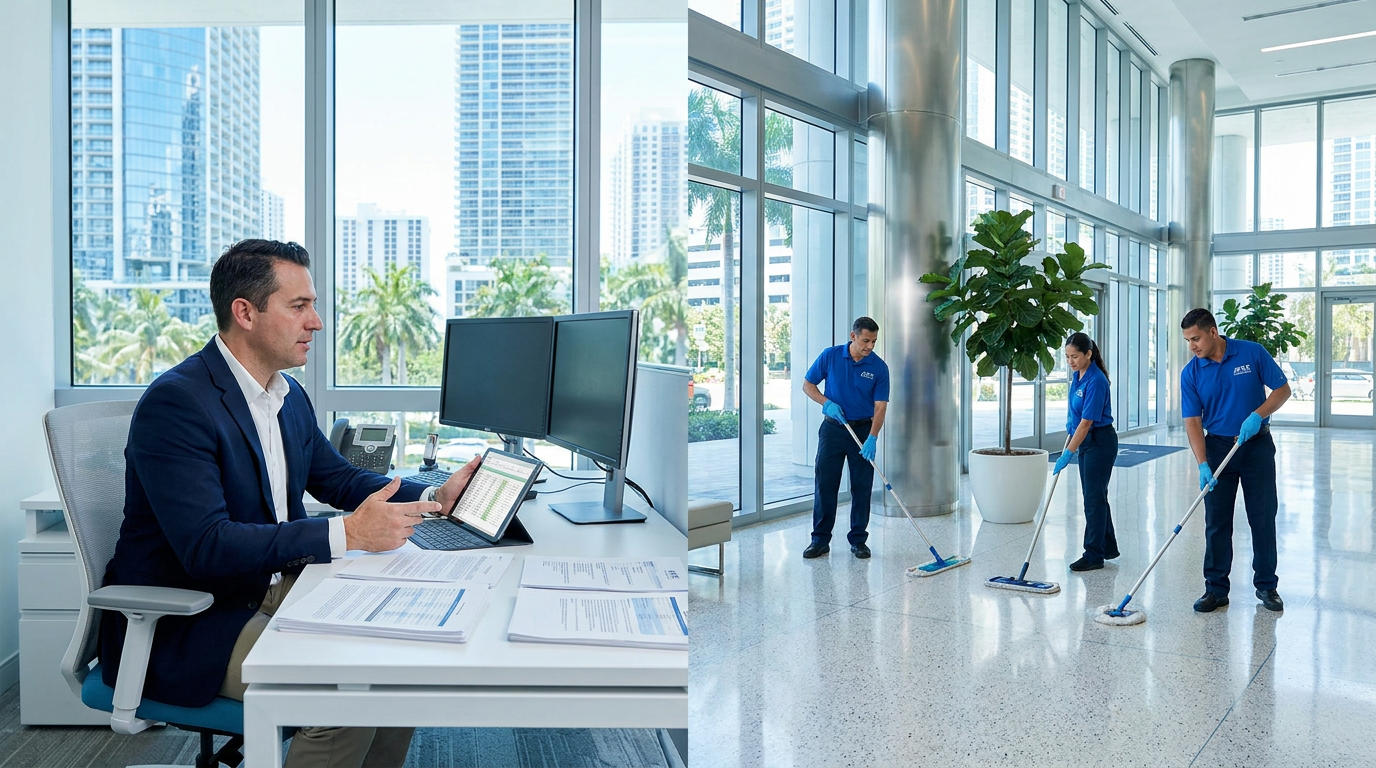
Outsourced commercial cleaning costs 30% to 50% less than in-house cleaning for most facilities under 50,000 square feet, according to ISSA (International Sanitary Supply Association) benchmarking data. In-house cleaning offers tighter daily control but requires managing payroll, equipment, training, and replacement coverage. The right choice depends on your facility size, cleaning complexity, and available management bandwidth.
- True in-house cleaning costs include wages plus 25% to 40% in hidden expenses (taxes, benefits, equipment, turnover)
- Outsourced cleaning contracts range from $0.05 to $0.25 per square foot monthly for routine janitorial
- In-house teams respond to emergencies in 5 to 15 minutes; outsourced providers typically need 2 to 24 hours
- Facilities under 25,000 square feet rarely justify a full-time dedicated cleaning employee
- The Bureau of Labor Statistics reports 49% annual turnover for janitorial roles, making coverage a constant challenge
The True Cost of In-House Commercial Cleaning
Most facility managers underestimate in-house cleaning costs by 30% or more. The visible cost is the hourly wage, typically $14 to $18 per hour in South Florida according to Bureau of Labor Statistics 2025 data. The invisible costs accumulate quickly and often exceed the base wage.
A full-time cleaning employee earning $16 per hour costs approximately $33,280 in base wages annually. Add employer payroll taxes (7.65% for FICA), workers compensation insurance (3% to 5% for cleaning roles), and basic benefits, and the true annual cost reaches $42,000 to $48,000 before equipment or supplies.
Hidden Cost Categories for In-House Teams
Equipment represents a significant upfront investment. A commercial auto-scrubber costs $3,000 to $12,000. HEPA-filtered vacuums run $400 to $1,200 each. Carpet extractors range from $2,500 to $8,000. These machines require maintenance, repairs, and eventual replacement every 5 to 7 years.
Supplies and consumables add $150 to $400 monthly per employee. This includes cleaning chemicals, microfiber cloths, mop heads, trash liners, paper products, and personal protective equipment. OSHA requires proper chemical storage, safety data sheets, and hazard communication training for all cleaning staff.
Supervision and management time often goes untracked. Someone must handle scheduling, quality checks, inventory ordering, performance reviews, and discipline. IFMA (International Facility Management Association) estimates this administrative burden at 4 to 8 hours weekly for a single cleaning employee.
The Turnover Problem
Janitorial positions experience 49% annual turnover according to Bureau of Labor Statistics data. Each departure triggers recruiting costs ($500 to $1,500), training time (20 to 40 hours), and productivity loss during the learning curve. A facility replacing one cleaner annually adds $2,000 to $4,000 in hidden costs.
Absence coverage creates another gap. When your sole cleaning employee calls in sick, takes vacation, or quits without notice, who cleans the facility? Temporary staffing agencies charge 40% to 60% markups over standard wages for short-notice placements.
What Outsourced Commercial Cleaning Actually Costs
Contract cleaning pricing varies by service frequency, facility type, and geographic market. In South Florida, routine janitorial services typically range from $0.05 to $0.15 per square foot monthly for basic nightly cleaning of office spaces. Medical facilities, food service areas, and high-traffic retail spaces command $0.12 to $0.25 per square foot.
A 10,000 square foot office building might pay $500 to $1,500 monthly for five-day-per-week janitorial service. That same building with an in-house part-time cleaner (20 hours weekly at $16 per hour) would spend $1,387 monthly in wages alone, before taxes, supplies, or equipment.
What Contract Pricing Includes
Reputable commercial cleaning companies bundle several cost categories into their contract price. Labor, supervision, supplies, equipment, insurance, and replacement coverage are typically included. BOMA International (Building Owners and Managers Association) recommends verifying these inclusions before signing any contract.
Quality vendors carry general liability insurance ($1 million to $2 million coverage), workers compensation insurance, and bonding. They provide trained, background-checked staff and handle all HR administration. If an employee is sick or quits, the vendor sends a replacement at no additional charge.
Add-On Services and Pricing
Routine janitorial contracts typically exclude periodic deep cleaning, floor restoration, and specialty services. Floor stripping and waxing runs $0.85 to $1.80 per square foot as a project-based service. Carpet deep cleaning costs $0.15 to $0.35 per square foot. Pressure washing ranges from $0.10 to $0.50 per square foot depending on surface type.
These periodic services are often more cost-effective through specialized vendors who own industrial-grade equipment. A professional commercial floor deep cleaning company brings ride-on scrubbers, truck-mounted extractors, and diamond polishing equipment that would cost $50,000 or more to purchase outright.
Cost Comparison: In-House vs Outsourced Cleaning
The following table compares annual costs for a 15,000 square foot commercial office building in South Florida, based on 2025 market rates and ISSA cleaning time standards.
| Cost Category | In-House (Annual) | Outsourced (Annual) |
|---|---|---|
| Base Labor/Contract | $33,280 | $12,600 |
| Payroll Taxes (7.65%) | $2,546 | Included |
| Workers Comp Insurance | $1,330 | Included |
| Equipment (Amortized) | $2,400 | Included |
| Supplies and Chemicals | $3,000 | Included |
| Supervision (6 hrs/week) | $7,800 | $0 |
| Turnover/Training | $2,500 | $0 |
| Total Annual Cost | $52,856 | $12,600 |
This comparison assumes five-day-per-week cleaning. The in-house model requires one full-time employee. The outsourced model uses a professional cleaning company at $0.07 per square foot monthly. Actual costs vary by facility complexity, cleaning scope, and local market rates.
Control and Quality: Where In-House Cleaning Wins
In-house cleaning provides advantages that matter for certain facility types. Direct supervision means immediate accountability. You can redirect staff to urgent tasks within minutes. There is no contract negotiation for scope changes.
Response Time Advantages
When a client spills coffee in your lobby at 2 PM, an in-house cleaner can respond in 5 to 15 minutes. An outsourced provider might not arrive until the next scheduled visit, which could be 6 to 24 hours later. For facilities where appearance directly impacts revenue, this gap matters.
Medical offices, food service establishments, and customer-facing retail locations often benefit from on-site cleaning staff. A study published in Facility Executive found that 67% of customers form quality impressions within the first 30 seconds of entering a business. Immediate spill response protects that impression.
Institutional Knowledge
Long-term in-house staff develop deep familiarity with your facility. They know which conference room gets heavy use on Tuesdays. They remember that the CEO prefers the trash emptied before 8 AM. They understand which tenant complains about noise and which one never locks their door.
This institutional knowledge takes 6 to 12 months to develop. Outsourced providers with high turnover may never reach this level of familiarity. However, quality vendors mitigate this through detailed site documentation, supervisor oversight, and consistent crew assignments.
Flexibility and Expertise: Where Outsourcing Wins
Professional cleaning companies bring capabilities that most in-house operations cannot match. They invest in commercial-grade equipment, specialized training, and industry certifications that would be cost-prohibitive for a single facility.
Equipment and Technology
A professional commercial deep cleaning company typically owns ride-on auto-scrubbers ($8,000 to $25,000), truck-mounted carpet extractors ($15,000 to $40,000), industrial pressure washers ($3,000 to $8,000), and HEPA-filtered air scrubbers ($1,500 to $4,000). This equipment delivers results impossible with consumer-grade tools.
Terrazzo floor restoration requires diamond polishing equipment and specialized compounds. VCT floor stripping needs commercial-strength chemicals and high-speed buffers. Marble crystallization demands specific pads and crystallizing compounds. Few in-house operations can justify these investments for periodic use.
Scalability and Coverage
Outsourced providers scale up or down without the pain of hiring or layoffs. Opening a new location? Add it to the contract. Closing for renovations? Pause service. Hosting a major event? Request extra crews. This flexibility is impossible with fixed in-house staff.
Coverage gaps disappear with professional vendors. They maintain backup crews for illness, vacations, and turnover. CBRE research indicates that facilities using outsourced cleaning experience 40% fewer service interruptions than those relying on in-house staff.
Decision Framework: Which Model Fits Your Facility?
The optimal cleaning model depends on five primary factors: facility size, cleaning complexity, control requirements, budget structure, and management capacity. Use the following framework to evaluate your situation.
Facility Size Thresholds
Facilities under 25,000 square feet rarely justify a dedicated full-time cleaning employee. The math simply does not work. A 15,000 square foot office needs approximately 15 to 20 hours of cleaning weekly according to ISSA time standards. That is a part-time position with all the challenges of part-time retention.
Facilities between 25,000 and 75,000 square feet fall into a gray zone. Either model can work depending on other factors. Facilities over 75,000 square feet can often support dedicated in-house staff economically, though outsourcing may still offer advantages.
Cleaning Complexity Assessment
Standard office cleaning (trash, vacuuming, restrooms, break rooms) is commodity work. Any reputable vendor can deliver consistent results. Outsourcing makes sense for routine janitorial needs.
Specialized environments change the calculation. Cleanrooms, medical facilities with infection control requirements, food processing plants, and research laboratories may benefit from dedicated in-house staff trained specifically for those environments. The learning curve is steeper, and the consequences of errors are more severe.
Control Requirements
Ask yourself: How often do cleaning emergencies occur? How quickly must they be addressed? What is the cost of a delayed response?
If spills, messes, or cleaning emergencies happen daily and require immediate attention, in-house staff provide faster response. If emergencies are rare (weekly or less), outsourced providers with next-day response may be sufficient. Some facilities use a hybrid model: minimal in-house staff for daytime emergencies plus outsourced crews for after-hours deep cleaning.
Industry-Specific Considerations
Different industries face unique cleaning challenges that influence the in-house versus outsourced decision. Understanding your industry context helps identify the right approach.
Hotels and Hospitality
Hotels typically maintain in-house housekeeping for guest rooms due to the volume, timing, and guest interaction requirements. However, many hotel properties outsource specialty cleaning such as marble floor restoration, ballroom carpet cleaning, and exterior pressure washing. This hybrid approach captures the benefits of both models.
Marriott International, Hilton, and Hyatt all use outsourced vendors for periodic deep cleaning while maintaining in-house daily housekeeping. The economics favor specialization: daily tasks go to internal staff, periodic projects go to specialists with the right equipment.
Schools and Daycares
Educational facilities face unique compliance requirements. Florida Department of Children and Families (DCF) mandates specific cleaning and sanitation standards for licensed childcare facilities. School and daycare deep cleaning must be documented with signed service completion records for inspection files.
Many schools maintain in-house custodial staff for daily cleaning during operational hours, then bring in outsourced crews for summer deep cleaning, floor restoration, and air duct cleaning during breaks. This scheduling aligns with the academic calendar and minimizes disruption.
Retail and Shopping Centers
Multi-tenant retail properties almost universally use outsourced cleaning. Managing in-house staff across multiple locations, coordinating after-hours access, and maintaining consistent standards is operationally complex. A single retail cleaning contract simplifies management and ensures uniform quality.
JLL (Jones Lang LaSalle), one of the largest commercial real estate services firms, reports that 89% of their managed retail properties use outsourced cleaning. The operational efficiency gains outweigh any perceived control benefits of in-house staff.
Office Buildings
Class A office buildings in major markets like Miami, Fort Lauderdale, and Boca Raton typically outsource janitorial services. Property management companies such as Cushman and Wakefield, CBRE, and JLL negotiate master service agreements with cleaning vendors that cover multiple properties.
Tenant satisfaction surveys consistently show that cleaning quality ranks among the top three factors influencing lease renewal decisions. Professional office building cleaning programs with documented quality assurance often outperform in-house operations on tenant satisfaction metrics.
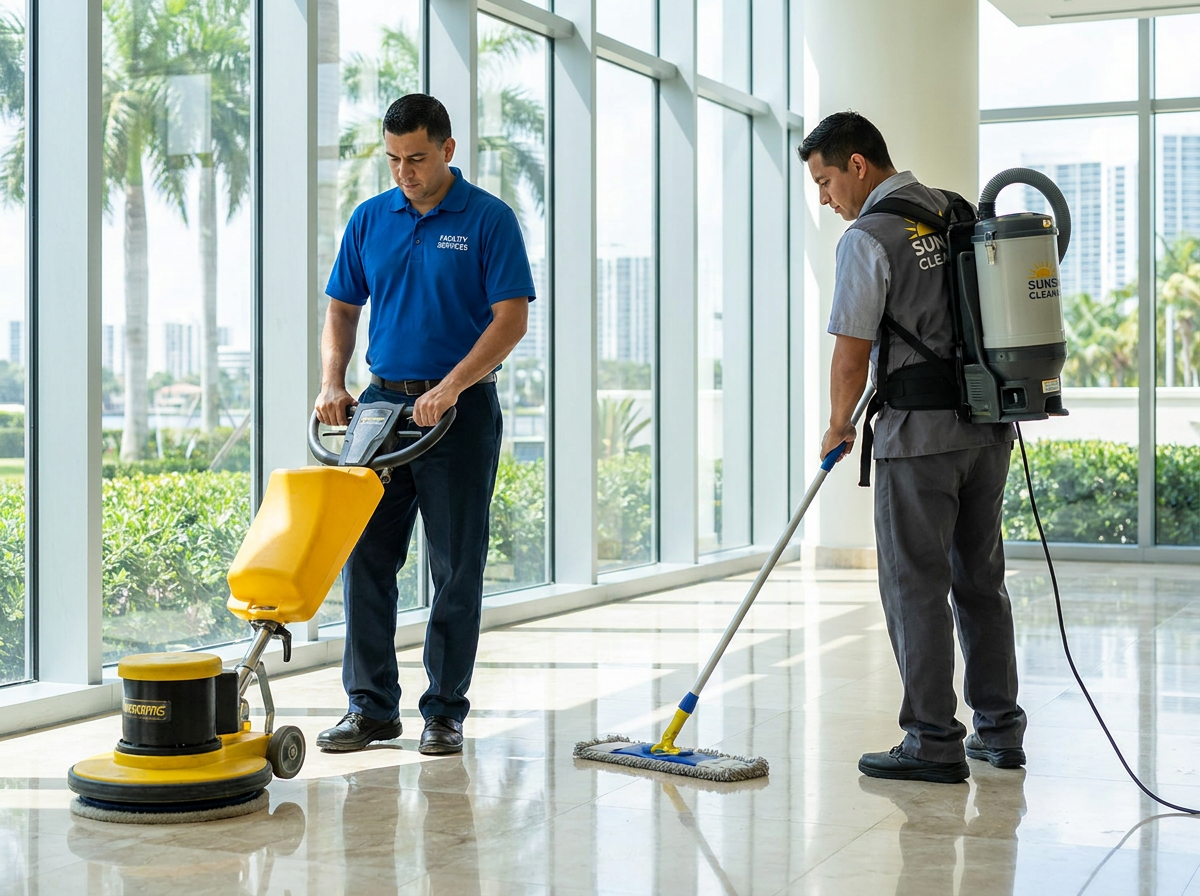
Vendor Selection: What to Look For
If you choose outsourced cleaning, vendor selection determines your results. Not all cleaning companies deliver equal value. Use these criteria to evaluate potential partners.
Insurance and Licensing Requirements
Verify general liability insurance with minimum $1 million coverage per occurrence. Request a certificate of insurance naming your company as additional insured. Confirm workers compensation insurance is active and adequate for the crew size.
In Florida, cleaning companies should hold a business license from the Florida Department of Business and Professional Regulation. SBE (Small Business Enterprise) and WOSB (Women-Owned Small Business) certifications indicate additional vetting and accountability.
Contract Structure Best Practices
Avoid contracts with vague scope definitions. Specify exactly which tasks are included, how often each task occurs, and what quality standards apply. BOMA International recommends contracts that define cleaning frequencies by area type (restrooms daily, carpets monthly, windows quarterly).
Include service-level agreements (SLAs) with measurable standards. Response time for complaints (24 to 48 hours), inspection frequency (weekly or monthly), and remediation procedures should be documented. Build in performance reviews at 90 days, 6 months, and annually.
Red Flags to Avoid
Pricing significantly below market rates signals corner-cutting. If a vendor quotes 40% less than competitors, they are likely underpaying workers, skipping insurance, or planning to reduce service quality after signing. ISSA data shows that cleaning labor accounts for 65% to 75% of service costs; there is limited room for legitimate price variation.
Reluctance to provide references, insurance certificates, or site visits indicates potential problems. Professional vendors welcome scrutiny because it differentiates them from unreliable competitors.
Frequently Asked Questions
Is commercial cleaning more profitable than residential cleaning?
Commercial cleaning generates higher revenue per account but requires more equipment, insurance, and operational complexity. A single commercial contract might generate $2,000 to $10,000 monthly compared to $150 to $400 for residential clients. However, commercial contracts require commercial auto-scrubbers ($5,000 to $15,000), higher liability insurance limits, and often after-hours scheduling. Profit margins are similar (15% to 25%) but commercial operations scale more efficiently.
What is the 80/20 rule in housekeeping?
The 80/20 rule in housekeeping states that 80% of visible dirt accumulates in 20% of the facility, typically high-traffic areas like entrances, restrooms, break rooms, and main corridors. Effective cleaning programs concentrate resources on these high-impact zones. ISSA training materials recommend allocating 50% to 60% of cleaning time to these critical areas rather than distributing effort evenly across all spaces.
What is the difference between in-house and outsourcing?
In-house cleaning means hiring employees directly on your payroll to perform cleaning tasks. You control hiring, training, scheduling, and supervision. You purchase equipment and supplies. You handle HR administration, payroll taxes, and workers compensation. Outsourcing means contracting with an external company that provides cleaning services. The vendor employs the workers, owns the equipment, and manages operations. You pay a contract fee and monitor results.
How much should you tip a house cleaner for a $500 job?
For residential cleaning, tipping 15% to 20% is customary for one-time or occasional services, which would be $75 to $100 on a $500 job. For regular recurring service, many clients tip $20 to $50 per visit or provide a larger holiday bonus equivalent to one cleaning session. Commercial cleaning contracts do not typically involve tipping; the contract price covers all compensation.
What should be included in a commercial cleaning contract?
A comprehensive commercial cleaning contract should specify: scope of work by area and frequency, pricing structure and payment terms, insurance requirements and certificates, term length and cancellation provisions, quality standards and inspection procedures, communication protocols and escalation paths, and procedures for scope changes or additional services. Request a free on-site assessment to develop accurate scope documentation.
Making Your Decision
The in-house versus outsourced cleaning decision ultimately comes down to three questions. First, what is your true total cost for each model, including hidden expenses? Second, how much control do you actually need on a daily basis? Third, do you have the management bandwidth to supervise cleaning operations effectively?
For most commercial facilities under 50,000 square feet in South Florida, outsourced cleaning delivers better value. The cost savings are substantial, the operational burden shifts to the vendor, and professional providers bring equipment and expertise that improve results.
Facilities with specialized requirements, high-frequency emergency cleaning needs, or strong existing management infrastructure may find in-house cleaning more appropriate. The hybrid model, combining minimal in-house staff with outsourced specialty services, often captures the best of both approaches.
Whatever model you choose, document your requirements clearly, establish measurable quality standards, and review performance regularly. Cleaning is not glamorous, but it directly impacts employee health, customer perception, and facility longevity. The investment in getting it right pays dividends across your entire operation.
Need Help Deciding?
MB Clean Solutions provides free on-site assessments for commercial facilities across Miami-Dade, Broward, and Palm Beach counties. Get transparent pricing and expert recommendations for your specific situation.
Get Your Free AssessmentKeep reading
More guides on the same topic from our team.
How to Choose a Commercial Cleaning Service for Office Buildings
Learn the 7 essential criteria for selecting a commercial cleaning service for office buildings, including pricing, certifications, and evaluation checklists.
Read the guide
Office Building Cleaning Checklist: Complete Guide for 2026
Comprehensive office building cleaning checklist covering daily, weekly, and monthly tasks. Includes high-touch surfaces, restrooms, floors, and deep cleaning schedules.
Read the guide
How to Prepare Your Office for Post-Construction Cleaning
Learn the exact steps to prepare an office for post-construction cleaning. Covers the 3 phases, common mistakes, and GC coordination for faster CO approval.
Read the guide
Ready for a Spotless Space?
Get a free, no-obligation estimate for your commercial cleaning project. Most quotes delivered within 24 hours.