Professional Floor Restoration Cost vs Replacement: 2026 Guide
PROFESSIONAL FLOOR RESTORATION COST VS REPLACEMENT
Floor restoration costs $1.50-$4/sq ft versus $8-$25/sq ft for replacement. Learn when restoration saves 60-85% and when replacement is the smarter investment.
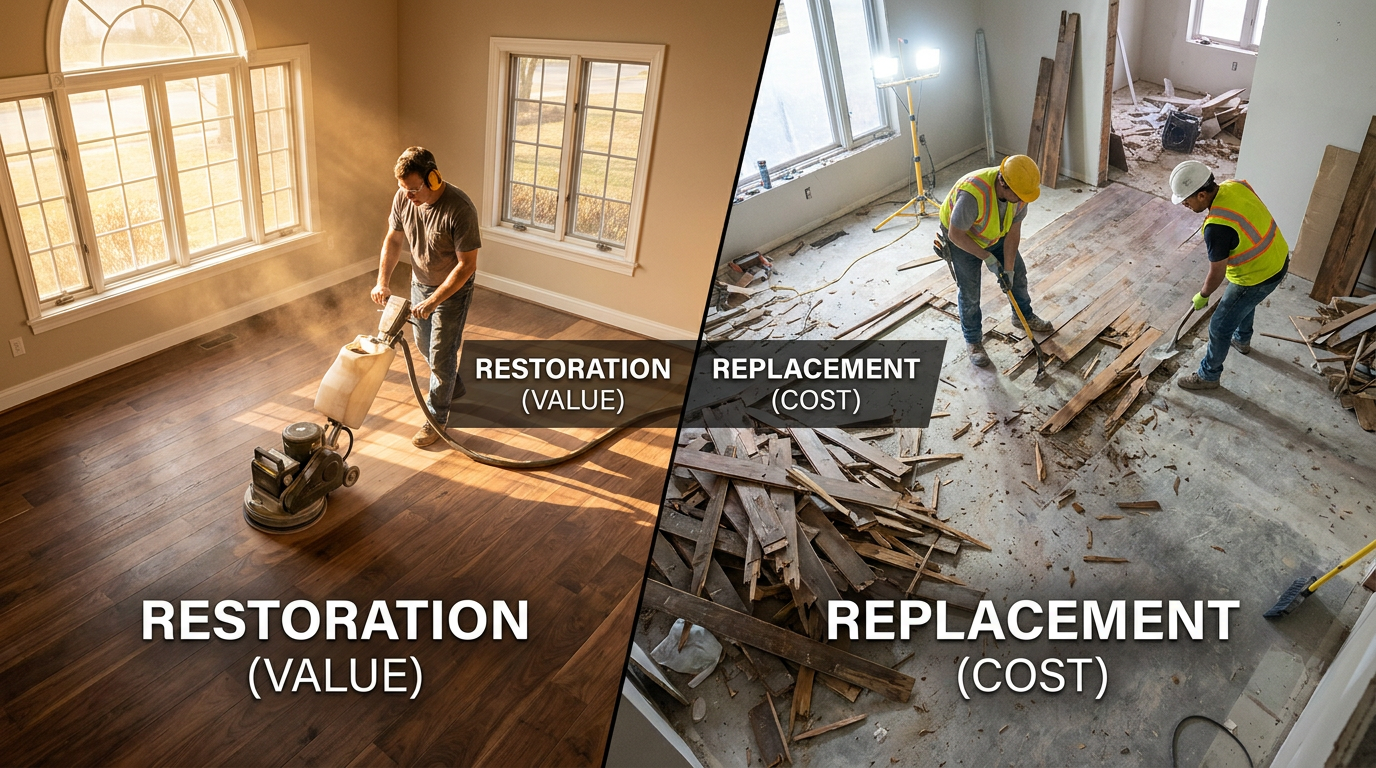
Professional floor restoration costs $1.50 to $4.00 per square foot, while full replacement runs $8.00 to $25.00 per square foot. For most commercial and residential floors with intact structural integrity, restoration delivers 60 to 85 percent savings compared to replacement, with faster completion times and minimal business disruption.
- Restoration costs $1.50-$4.00/sq ft; replacement costs $8.00-$25.00/sq ft (60-85% savings)
- Structural integrity determines the decision: sound subfloor means restoration wins
- Commercial restoration completes in 1-3 days versus 5-14 days for replacement
- VCT, terrazzo, hardwood, marble, and concrete floors are prime restoration candidates
- Replacement becomes necessary with water damage, subfloor rot, or repeated failures
Complete Cost Comparison: Restoration vs Replacement by Floor Type
According to data from Angi and HomeAdvisor, the cost gap between restoration and replacement varies significantly by material. The National Wood Flooring Association reports that hardwood refinishing extends floor life by 20 to 30 years, making restoration the clear financial winner for structurally sound floors.
| Floor Type | Restoration Cost/Sq Ft | Replacement Cost/Sq Ft | Potential Savings |
|---|---|---|---|
| VCT (Vinyl Composition Tile) | $0.85-$1.80 | $3.00-$7.00 | 70-75% |
| Hardwood | $3.00-$5.00 | $8.00-$15.00 | 60-67% |
| Terrazzo | $2.00-$4.00 | $15.00-$30.00 | 85-87% |
| Marble | $3.00-$6.00 | $20.00-$50.00 | 85-88% |
| Polished Concrete | $2.00-$4.00 | $8.00-$18.00 | 75-78% |
| Ceramic Tile | $1.50-$3.00 | $7.00-$14.00 | 78-79% |
For a 5,000 square foot commercial space, this translates to concrete numbers. Restoring VCT floors costs $4,250 to $9,000, while replacement runs $15,000 to $35,000. That is $10,750 to $26,000 in direct savings before accounting for reduced downtime and business interruption costs.
Hidden Costs That Make Replacement More Expensive
The per-square-foot pricing gap tells only part of the story. According to the International Facility Management Association (IFMA), replacement projects carry substantial hidden costs that restoration avoids entirely. These secondary expenses often add 30 to 50 percent to the total replacement budget.
Demolition and Disposal Fees
Removing existing flooring costs $1.00 to $3.00 per square foot for labor alone. Disposal fees for commercial flooring materials range from $25 to $75 per ton, according to the Construction and Demolition Recycling Association. A 10,000 square foot VCT removal generates approximately 2 to 3 tons of waste, adding $50 to $225 in disposal costs.
Subfloor Preparation
Once old flooring comes up, subfloor issues often emerge. The Resilient Floor Covering Institute reports that 40 percent of commercial floor replacements require subfloor leveling or repair, adding $1.50 to $3.00 per square foot. Moisture mitigation systems, common in South Florida properties, add another $3.00 to $6.00 per square foot.
Business Interruption Costs
The Building Owners and Managers Association (BOMA) estimates that commercial floor replacement causes 3 to 5 times longer disruption than restoration. A retail space losing $500 per day in revenue faces $2,500 to $7,000 in lost sales during a typical replacement versus $500 to $1,500 during restoration.
When Floor Restoration Delivers Maximum Value
Floor restoration provides the highest return on investment when specific conditions exist. The Marble Institute of America and the National Terrazzo and Mosaic Association both recommend restoration as the first option when structural integrity remains intact.
VCT and Commercial Vinyl Floors
VCT floors in schools, hospitals, and retail spaces respond exceptionally well to professional floor stripping and waxing services. When yellowing, scuff marks, or dull finishes are the primary concerns, restoration costs $0.85 to $1.80 per square foot and extends floor life by 5 to 10 years.
The key indicators for VCT restoration success include: finish wear limited to the top layers, no cracking or lifting at seams, tiles remaining firmly adhered, and subfloor moisture readings below 75 percent relative humidity. Facilities meeting these criteria see 90 percent restoration success rates.
Hardwood Floor Refinishing
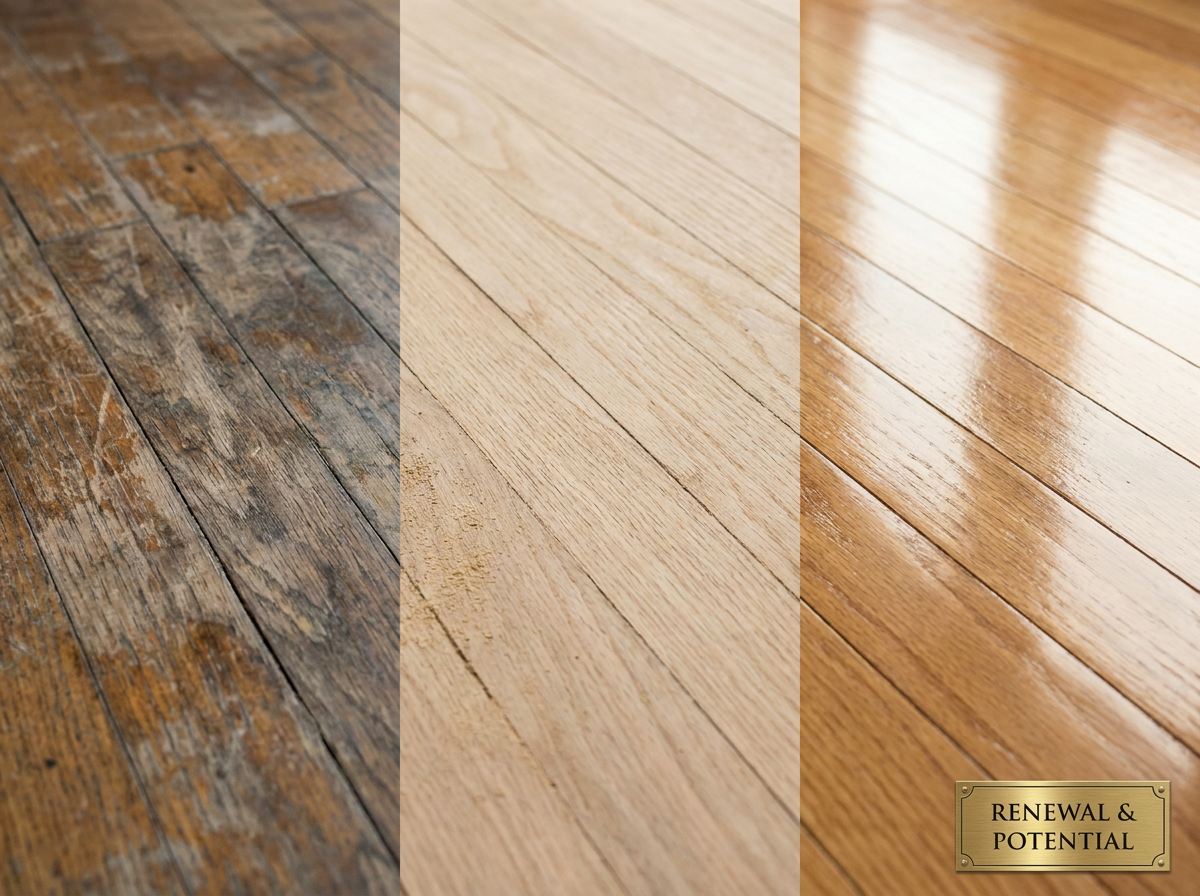
The National Wood Flooring Association confirms that solid hardwood floors can be refinished 4 to 6 times over their lifespan, depending on wood thickness. At $3.00 to $5.00 per square foot for refinishing versus $8.00 to $15.00 for replacement, the math strongly favors restoration when boards remain stable.
Refinishing works best when: scratches and wear marks do not penetrate below the finish layer, boards show no cupping or warping, the wood thickness exceeds 3/4 inch, and no evidence of termite or water damage exists. A professional assessment identifies these factors within 15 to 30 minutes.
Terrazzo and Natural Stone
Terrazzo restoration represents one of the clearest cases for professional restoration over replacement. According to the National Terrazzo and Mosaic Association, original terrazzo floors from the 1920s through 1960s often contain higher quality marble chips than modern installations. Grinding, honing, and polishing these floors costs $2.00 to $4.00 per square foot.
Replacement terrazzo installation runs $15.00 to $30.00 per square foot, making restoration 85 to 87 percent more cost-effective. South Florida properties with original terrazzo, common in Miami Beach, Coral Gables, and Fort Lauderdale, benefit significantly from professional restoration. Hotel and hospitality properties regularly choose terrazzo restoration to preserve architectural character.
When Replacement Becomes the Better Investment
Despite restoration's cost advantages, replacement delivers better long-term value under specific circumstances. The American Institute of Architects recommends replacement when structural issues exist or when the floor no longer meets safety or performance requirements.
Structural Damage Indicators
Replacement becomes necessary when floors exhibit: subfloor rot or deterioration, widespread delamination affecting more than 30 percent of the surface, repeated restoration failures within 2 years, or moisture damage extending below the surface material. These conditions make restoration a temporary fix rather than a lasting solution.
Safety and Compliance Issues
Modern building codes from the International Code Council (ICC) require specific slip resistance ratings for commercial floors. The Americans with Disabilities Act (ADA) mandates coefficient of friction values of 0.6 or higher for accessible routes. When existing floors cannot meet these standards through restoration, replacement becomes mandatory.
Total Lifecycle Cost Analysis
The Facility Management Journal recommends calculating total cost of ownership over 10 to 15 years. If a floor requires restoration every 18 months at $2.00 per square foot, the 10-year cost reaches $13.33 per square foot. Replacement at $10.00 per square foot with 10-year durability becomes the better investment.
| Condition | Recommended Action | Reasoning |
|---|---|---|
| Surface scratches, dullness, minor stains | Restoration | 60-85% cost savings, 1-3 day completion |
| Yellowed wax buildup, scuff marks | Restoration (strip and wax) | Removes all old finish, applies fresh coats |
| Cracking affecting less than 10% of surface | Restoration with spot repairs | Localized repairs plus full restoration |
| Subfloor moisture above 80% RH | Replacement with moisture mitigation | Restoration will fail without addressing source |
| Widespread delamination (30%+ of area) | Replacement | Restoration cannot address adhesion failure |
| Previous restoration failed within 2 years | Replacement | Underlying issues require material change |
Commercial Floor Restoration: Industry-Specific Considerations
Different commercial environments present unique restoration challenges. The International Sanitary Supply Association (ISSA) publishes cleaning and restoration standards that vary by facility type, affecting both cost and methodology.
Retail and Shopping Centers
Retail floors experience 10,000 to 50,000 footfalls daily, according to the International Council of Shopping Centers. This traffic pattern creates specific wear patterns near entrances, checkout areas, and high-traffic aisles. Professional retail floor cleaning services address these patterns with targeted restoration.
Restoration scheduling matters significantly in retail. After-hours work between 10 PM and 6 AM avoids customer disruption. A 15,000 square foot retail space requires 2 to 3 nights for complete VCT restoration versus 7 to 10 days for replacement, reducing revenue impact by 70 percent.
Schools and Educational Facilities
The Florida Department of Children and Families (DCF) requires specific floor maintenance documentation for licensed childcare facilities. School and daycare cleaning services must use low-VOC products and provide signed service completion records for inspection files.
Summer break restoration windows span 8 to 10 weeks, sufficient for comprehensive floor restoration across multiple buildings. Replacement projects often extend into the school year, creating scheduling conflicts and potential compliance issues.
Office Buildings
Class A office buildings in markets like Brickell, downtown Miami, and Fort Lauderdale face tenant satisfaction pressures. According to BOMA, floor appearance ranks among the top 5 factors affecting tenant retention. Office building cleaning programs that include quarterly floor maintenance reduce tenant complaints by 40 percent.
Multi-tenant buildings benefit from phased restoration approaches. Restoring common areas, lobbies, and corridors during low-traffic periods minimizes disruption while maintaining professional appearance standards that support premium lease rates.
South Florida Climate Impact on Floor Restoration
South Florida's subtropical climate creates unique floor maintenance challenges. The National Oceanic and Atmospheric Administration (NOAA) reports Miami-Dade County averages 62 inches of annual rainfall and 90 percent relative humidity during summer months. These conditions accelerate floor finish degradation.
Humidity Effects on Floor Finishes
High humidity causes floor wax to soften and yellow faster than in drier climates. The Resilient Floor Covering Institute recommends 3 to 4 month scrub and recoat cycles for South Florida VCT floors versus 6 month intervals in northern states. This maintenance-level service costs $0.60 to $1.50 per square foot and extends time between full strip-and-wax procedures.
Salt Air and Coastal Properties
Properties within 5 miles of the Atlantic Ocean or Biscayne Bay face accelerated finish breakdown from salt air exposure. The Florida Building Code requires enhanced moisture barriers for coastal construction, and existing floors in these areas often need more frequent restoration.
Terrazzo and marble floors in coastal Miami Beach and Fort Lauderdale properties benefit from crystallization treatments during restoration. This process creates a chemical bond with the stone surface, improving resistance to humidity-related etching and staining.
The Professional Assessment Process
Accurate restoration versus replacement decisions require professional evaluation. The World Floor Covering Association recommends on-site assessments that examine multiple factors beyond surface appearance.
What a Professional Assessment Includes
A comprehensive floor assessment covers: moisture testing using calcium chloride or relative humidity probes, adhesion testing for resilient flooring, thickness measurement for hardwood and stone, identification of previous restoration or repair work, and documentation of damage patterns. This evaluation typically takes 30 to 60 minutes for spaces under 10,000 square feet.
Professional assessments identify issues invisible to untrained eyes. Moisture readings above 75 percent relative humidity indicate potential adhesion problems. Uneven wear patterns suggest subfloor irregularities. Previous improper restoration work may require removal before new treatment.
Getting an Accurate Quote
Restoration quotes should include: square footage calculations, floor type identification, condition assessment, recommended treatment protocol, timeline estimates, and warranty terms. A free on-site floor assessment provides this information without obligation, allowing informed comparison between restoration and replacement options.
Frequently Asked Questions
Is it cheaper to have floors refinished or replaced?
Refinishing costs 60 to 85 percent less than replacement in most cases. Hardwood refinishing runs $3.00 to $5.00 per square foot versus $8.00 to $15.00 for replacement. VCT restoration costs $0.85 to $1.80 per square foot compared to $3.00 to $7.00 for new installation. The savings increase for premium materials like terrazzo and marble.
What color floors are in for 2026?
According to the National Wood Flooring Association and Floor Covering Weekly, 2026 floor trends favor natural tones and warm neutrals. Light oak, honey maple, and warm gray finishes dominate residential preferences. Commercial spaces trend toward polished concrete and luxury vinyl plank in greige and taupe tones. Restoration can achieve these looks through staining and finish selection.
Should I restore or replace the floor?
Restore the floor when structural integrity remains intact, damage is primarily cosmetic, and the material can be refinished. Replace when subfloor damage exists, moisture problems persist, the floor has failed multiple restorations, or safety requirements mandate different materials. A professional assessment determines which option delivers better long-term value.
How much does laminate flooring cost for a 2,000 sq ft house?
Laminate flooring installation for a 2,000 square foot home costs $6,000 to $16,000, according to HomeAdvisor data. This includes $3.00 to $8.00 per square foot for materials and installation. Note that laminate cannot be refinished, making it a replacement-only option when worn. Hardwood or engineered wood alternatives offer restoration potential for long-term value.
Making the Final Decision
The restoration versus replacement decision ultimately depends on three factors: current floor condition, budget constraints, and long-term facility plans. For most commercial properties in South Florida, professional commercial floor deep cleaning and restoration provides superior value when floors remain structurally sound.
Properties planning major renovations within 3 to 5 years may benefit from restoration as a bridge solution. Those expecting 10 or more years in the same location should evaluate total lifecycle costs, including maintenance frequency and expected restoration intervals.
The most cost-effective approach combines professional assessment with realistic condition evaluation. Locally owned commercial cleaning companies with floor restoration expertise can provide unbiased recommendations based on actual floor conditions rather than sales targets.
Get a Free Floor Assessment
MB Clean Solutions provides complimentary on-site floor assessments for commercial properties across Miami-Dade, Broward, and Palm Beach counties. Our team identifies whether restoration or replacement delivers better value for your specific situation, with quotes delivered within 24 hours.
Schedule Your Free AssessmentSiga leyendo
Más guías sobre el mismo tema.
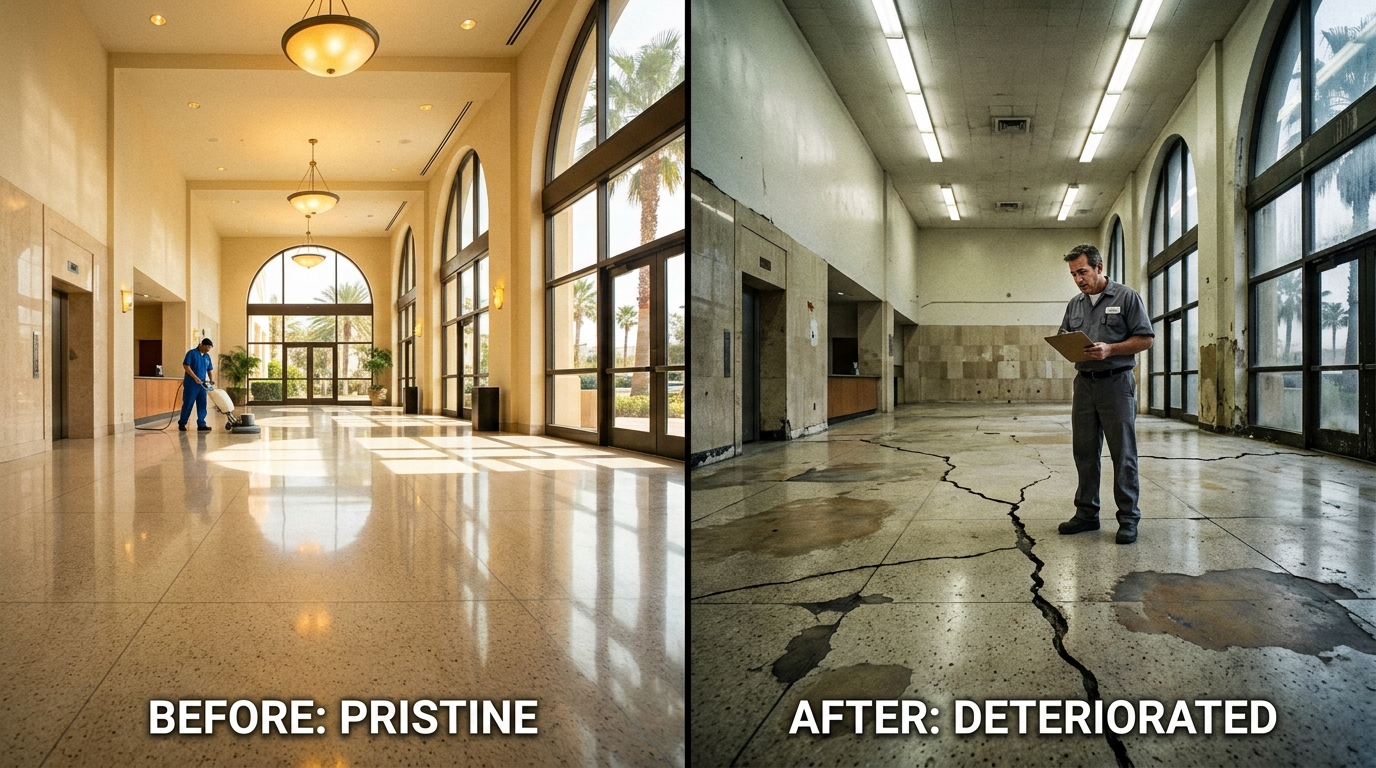
Floor Maintenance Program Cost vs Reactive Repairs: Full Analysis
Reactive floor repairs cost 3 to 5 times more than planned maintenance. See the full cost breakdown by floor type, plus ROI data for South Florida facilities.
Leer la guía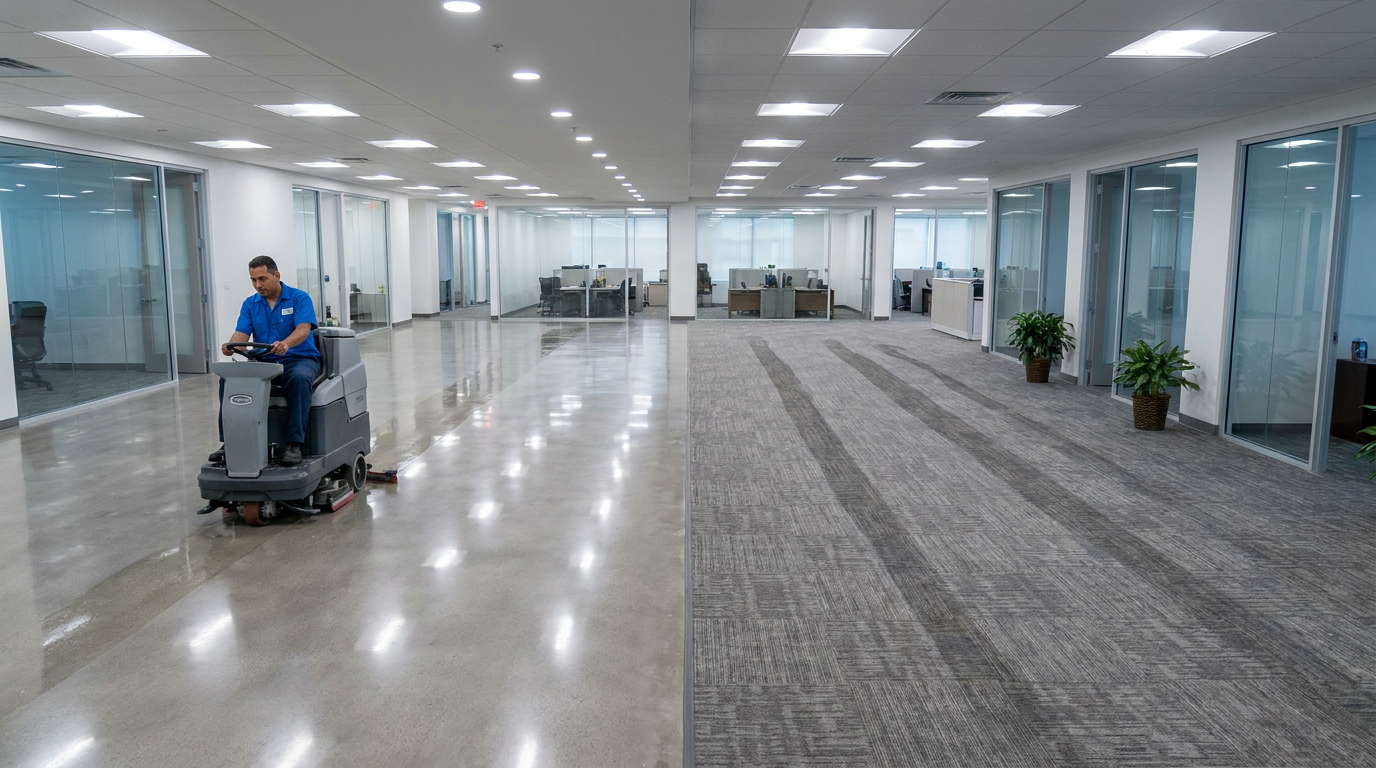
Commercial Carpet vs Hard Floor Maintenance Costs: 10-Year Analysis
Compare commercial carpet and hard floor maintenance costs over 10 years. Includes VCT, polished concrete, and carpet data with real pricing for South Florida facilities.
Leer la guía
ROI of Professional Floor Maintenance Programs for Commercial Buildings
Professional floor maintenance programs deliver 9-18 month payback periods. Learn how to calculate ROI, reduce costs, and extend floor life in commercial facilities.
Leer la guía
¿Listo Para un Espacio Impecable?
Obtenga un estimado gratis y sin compromiso para su proyecto de limpieza comercial. La mayoría de las cotizaciones se entregan en 24 horas.